Subgrade
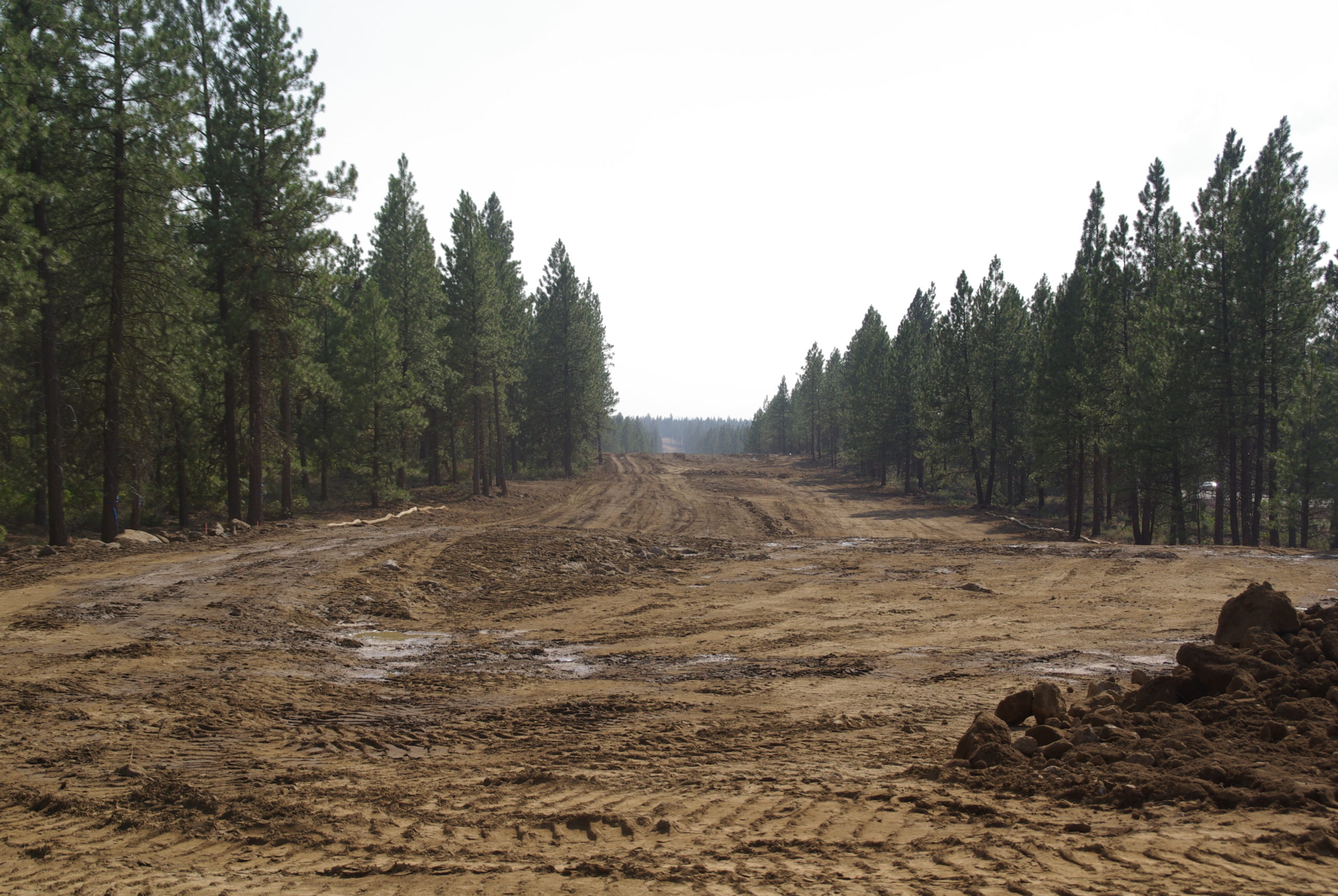
The "subgrade" is the in situ material upon which the pavement structure is placed. Although there is a tendency to look at pavement performance in terms of pavement structure and mix design alone, the subgrade can often be the overriding factor in pavement performance.


Subgrade Performance
A subgrade’s performance generally depends on two interrelated characteristics:
- Load bearing capacity. The subgrade must be able to support loads transmitted from the pavement structure. This load bearing capacity is often affected by degree of compaction, moisture content, and soil type. A subgrade that can support a high amount of loading without excessive deformation is considered good.
- Volume changes. Most soils undergo some amount of volume change when exposed to excessive moisture or freezing conditions. Some clay soils shrink and swell depending upon their moisture content, while soils with excessive fines may be susceptible to frost heave in freezing areas. Ash, especially on the Big Island, can present volume change problems.
Poor subgrade should be avoided if possible, but when it is necessary to build over weak soils there are several methods used to improved subgrade performance:
- Removal and replacement (over-excavation). Poor subgrade soil can simply be removed and replaced with higher quality fill. Although this is simple in concept, it can be expensive.
- Stabilization with a cementitious or asphaltic binder. The addition of an appropriate binder (such as lime, portland cement or emulsified asphalt) can increase subgrade stiffness and/or reduce swelling tendencies.
- Additional base layers. Marginally poor subgrade soils may be made acceptable by using additional base layers. These layers spread pavement loads over a larger subgrade area. This option is rather perilous; when designing pavements for poor subgrades the temptation may be to just design a thicker section with more base material because the thicker section will satisfy most design equations. However, these equations are at least in part empirical and were usually not intended to be used in extreme cases. In short, a thick pavement structure over a poor subgrade may not make a good pavement.
Subgrade Physical Properties
Subgrade materials are typically characterized by (1) their resistance to deformation under load, in other words, their stiffness or (2) their bearing capacity, in other words, their strength. In general, the more resistant to deformation a subgrade is, the more load it can support before reaching a critical deformation value. Although there are other factors involved when evaluating subgrade materials (such as shrink/swell in the case of certain clays and ash), stiffness is the most common characterization. There are three basic subgrade stiffness/strength characterizations commonly used in the U.S.:
- California bearing ratio (CBR). A simple test that compares the bearing capacity of a material with that of a well-graded crushed stone (thus, a high quality crushed stone material should have a CBR of about 100%). CBR is basically a measure of strength. It is primarily intended for, but not limited to, evaluating the strength of non-stabilized cohesive materials having maximum particle sizes less than 0.75 inches (AASHTO, 20001). It was developed by the California Division of Highways around 1930 and was subsequently adopted by numerous states, counties, U.S. federal agencies and internationally. Most agency and commercial geotechnical laboratories in the U.S. are equipped to perform CBR tests.
- Resistance value (R-Value). A test that expresses a material's resistance to deformation as a function of the ratio of transmitted lateral pressure to applied vertical pressure. It is essentially a modified triaxial compression test. Materials tested are assigned an R-value. The testing apparatus used in the R-value test is called a stabilometer and is identical to the one used in Hveem HMA mix design. The R-Value is basically a measure of stiffness.
- Resilient modulus (). A test used to estimate elastic modulus (a material's stress-strain relationship). The resilient modulus test applies a repeated axial cyclic stress of fixed magnitude, load duration and cycle duration to a cylindrical test specimen. While the specimen is subjected to this dynamic cyclic stress, it is also subjected to a static confining stress provided by a triaxial pressure chamber. It is essentially a cyclic version of a triaxial compression test; the cyclic load application is thought to more accurately simulate actual traffic loading. Resilient modulus is basically a measure of stiffness.
| Material (USC given where appropriate) | CBR | R-Value | Elastic or Resilient Modulus (psi) |
|---|---|---|---|
| Diamond | – | – | 170,000,000 |
| Steel | – | – | 30,000,000 |
| Aluminum | – | – | 10,000,000 |
| Wood | – | – | 1 – 2,000,000 |
| Crushed Stone (GW, GP, GM) | 20 – 100 | 30 – 50 | 20,000 – 40,000 |
| Sandy Soils (SW, SP, SM, SC) | 5 – 40 | 7 – 40 | 7,000 – 30,000 |
| Silty Soils (ML, MH) | 3 – 15 | 5 – 25 | 5,000 – 20,000 |
| Clay Soils (CL, CH) | 3 – 10 | 5 – 20 | 5,000 – 15,000 |
| Organic Soils (OH, OL, PT) | 1 – 5 | Less than 7 | Less than 5,000 |
There are many different correlation equations between CBR, R-value and resilient modulus. Each one has its limitations, which should be headed. Table 2 presents some of the more popular correlation equations.
| Equation | Origin | Limitations |
|---|---|---|
| M_R = (1500)(CBR) | Heukelom & Klomp (1962) | Only for fine-grained non-expansive soils with a soaked CBR of 10 or less. |
| M_R = 1,000 + (555)(R-value) | 1993 AASHTO Guide | Only for fine-grained non-expansive soils with R-values of 20 or less. |
| M_R= 2555 x CBR0.64 | AASHTO 2002 Design Guide | A fair conversion over a wide range of values. |
Soil Classification and Field Checks
Subgrade soils are described with the AASHTO and Unified (USCS) classification systems. Both separate coarse-grained from fine-grained soils by the percentage passing the 0.075 mm (No. 200) sieve, then divide coarse soils into gravels and sands and fine soils into silts and clays, though their definitions differ in detail. In general, gravelly soils have greater strength and resistance to frost action than sandy, silty or clayey soils. Organic matter is undesirable in any part of the roadway, and highly organic soils such as peat must be removed and replaced with more stable material.
The right fines content depends on how the material will be used. A base course is usually a dense-graded material with some of every particle size but a low percentage of fines, while the surfacing of a gravel road needs somewhat more fines. For that reason the surfacing of a gravel road may be too soft to serve as a base when the road is paved, and converting a gravel road to a paved road is not necessarily as simple as adding an asphalt overlay or a chip seal.
Simple field checks can give a rough idea of soil quality before samples are tested:
- Durability. Larger particles struck with a hammer give a clear "ping" when they are sound and durable and a dull "thunk" when they are weaker and less resistant to abrasion.
- Plasticity. Fines passing the 0.425 mm (No. 40) sieve are mixed with water into a paste. A soil whose paste rolls into a thread that holds together when picked up, or whose dried paste holds together when pinched, has higher plasticity; a low-plasticity soil falls apart easily.
These checks are informal and do not replace sampling and testing to the project specification. Plasticity is measured by the plasticity index from the Atterberg limits or by the sand equivalent test. There is no direct relationship between the two, so one cannot be converted to the other; the sand equivalent is more sensitive when the fines content is relatively low, and the plasticity index was developed for higher fines contents. Strength-related tests such as the CBR and the dynamic cone penetrometer (DCP), by contrast, can be correlated with each other.
Teaching this? Figures and worked examples are free to use with credit. How to cite
Cite this page
APA
Pavement Interactive. (2026, November 1). Subgrade. HeadLight. Retrieved [the date you read it], from https://pavementinteractive.org/reference-desk/design/design-parameters/subgrade/
ASCE
Pavement Interactive. (2026). “Subgrade.” HeadLight, <https://pavementinteractive.org/reference-desk/design/design-parameters/subgrade/> ([the date you read it]).
BibTeX
@misc{pavint-subgrade,
  author = {{Pavement Interactive}},
  title = {Subgrade},
  year = {2026},
  publisher = {HeadLight},
  howpublished = {\url{https://pavementinteractive.org/reference-desk/design/design-parameters/subgrade/}},
  note = {Accessed [date]}
}Sources (1)
- AASHTO (2000a). Standard Specifications for Transportation Materials and Methods of Sampling and Testing, Twentieth Edition. American Association of State Highway and Transportation Officials. Washington, D.C. ↩