Superpave Mix Design
Reviewed by licensed engineers
Checked against its sources by licensed professional engineers on the previous site, where reviewers weren’t recorded by name.
One of the principal results from the Strategic Highway Research Program (SHRP) was the Superpave mix design method. The Superpave mix design method was designed to replace the Hveem and Marshall methods. The volumetric analysis common to the Hveem and Marshall methods provides the basis for the Superpave mix design method. The Superpave system ties asphalt binder and aggregate selection into the mix design process, and considers traffic and climate as well. The compaction devices from the Hveem and Marshall procedures have been replaced by a gyratory compactor and the compaction effort in mix design is tied to expected traffic.
Like the Hveem and Marshall methods, the Superpave method has been proven to produce quality HMA from which long-lasting pavements can be constructed.
This section consists of a brief history of the Superpave mix design method followed by a general outline of the actual method. This outline emphasizes general concepts and rationale over specific procedures. Typical procedures are available in the following documents:
- Roberts, F.L.; Kandhal, P.S.; Brown, E.R.; Lee, D.Y. and Kennedy, T.W. (19961). Hot Mix Asphalt Materials, Mixture Design, and Construction. National Asphalt Pavement Association Education Foundation. Lanham, MD.
- Asphalt Institute. (20012). Superpave Mix Design. Superpave Series No. 2 (SP-02). Asphalt Institute. Lexington, KY.
- American Association of State Highway and Transportation Officials (AASHTO). (20003 and 20014). AASHTO Provisional Standards. American Association of State Highway and Transportation Officials. Washington, D.C.
Superpave History
Under the Strategic Highway Research Program (SHRP), an initiative was undertaken to improve materials selection and mixture design by developing:
- A new mix design method that accounts for traffic loading and environmental conditions.
- A new method of asphalt binder evaluation.
- New methods of mixture analysis.
When SHRP was completed in 1993 it introduced these three developments and called them the Superior Performing Asphalt Pavement System (Superpave). Although the new methods of mixture performance testing have not yet been established, the mix design method is well-established.
Superpave Procedure
The Superpave mix design method consists of 7 basic steps:
- Aggregate selection.
- Asphalt binder selection.
- Sample preparation (including compaction).
- Performance Tests.
- Density and voids calculations.
- Optimum asphalt binder content selection.
- Moisture susceptibility evaluation.
Aggregate Selection
Superpave specifies aggregate in two ways. First, it places restrictions on aggregate gradation by means of broad control points. Second, it places "consensus requirements" on coarse and fine aggregate angularity, flat and elongated particles, and clay content. Other aggregate criteria, which the Asphalt Institute (20012) calls "source properties" (because they are considered to be source specific) such as L.A. abrasion, soundness and water absorption are used in Superpave but since they were not modified by Superpave they are not discussed here.
Gradation and Size
Aggregate gradation influences such key HMA parameters as (read about these parameters here) stiffness, stability, durability, permeability, workability, fatigue resistance, frictional resistance and resistance to moisture damage (Roberts et al., 19961). Additionally, the maximum aggregate size can be influential in compaction and lift thickness determination.
Gradation Specifications
Superpave mix design specifies aggregate gradation control points, through which aggregate gradations must pass. These control points are very general and are a starting point for a job mix formula.
Aggregate Blending
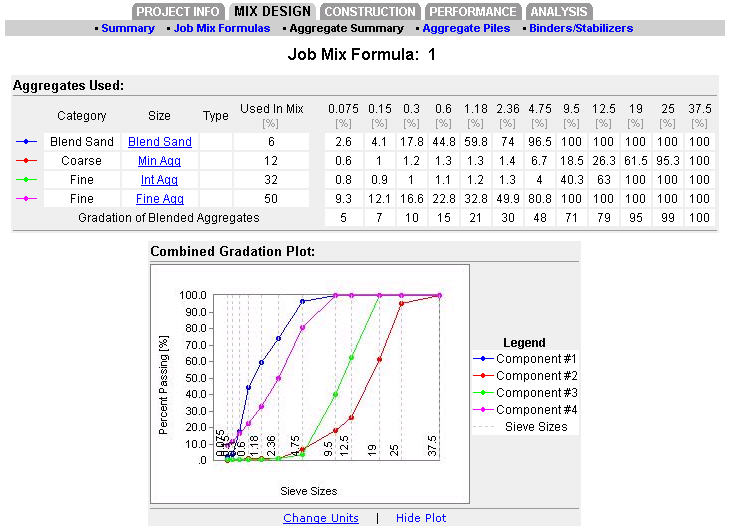
It is rare to obtain a desired aggregate gradation from a single aggregate stockpile. Therefore, Superpave mix designs usually draw upon several different aggregate stockpiles and blend them together in a ratio that will produce an acceptable final blended gradation. It is quite common to find a Superpave mix design that uses 3 or 4 different aggregate stockpiles (Figure 1).
where:
- = mass of particles passing the 0.075 mm (No. 200) sieve
- = effective binder content = the total asphalt binder content of a paving mixture less the portion of asphalt binder that is lost by absorption into the aggregate particles.
Asphalt Binder Selection
Superpave PG asphalt binders are selected based on the expected pavement temperature extremes in the area of their intended use. These extremes can be calculated using software (such as LTPPBind) or, more commonly, a standard grade of PG 64-16 is used statewide.
Sample Preparation
Prepare several initial samples, usually two at the proposed design asphalt content, two at 0.5 percent below the design asphalt content and two at 0.5 percent above the design asphalt content. Compact these trial mixes in the Superpave Gyratory Compactor. This compactor is specific to the Superpave mix design method.
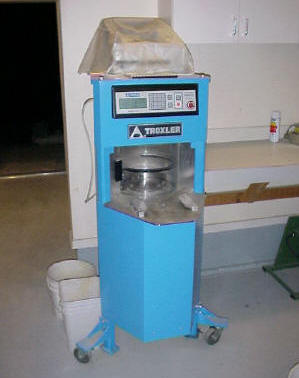


The Superpave gyratory compactor establishes three different gyration numbers:
- . The number of gyrations used as a measure of mixture compactability during construction. Mixes that compact too quickly (air voids at are too low) may be tender during construction and unstable when subjected to traffic. Often, this is a good indication of aggregate quality - HMA with excess natural sand will frequently fail the requirement. A mixture designed for greater than or equal to 3 million ESALs with 4 percent air voids at should have at least 11 percent air voids at .
- . This is the design number of gyrations required to produce a sample with the same density as that expected in the field after the indicated amount of traffic. A mix with 4 percent air voids at is desired in mix design.
- . The number of gyrations required to produce a laboratory density that should never be exceeded in the field. If the air voids at are too low, then the field mixture may compact too much under traffic resulting in excessively low air voids and potential rutting. The air void content at should never be below 2 percent air voids.
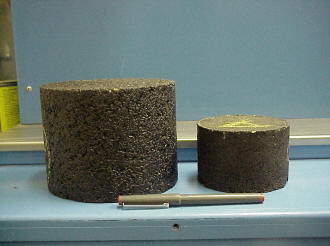
Typically, samples are compacted to to establish the optimum asphalt binder content and then additional samples are compacted to as a check. Previously, samples were compacted to and then and were back calculated. Table 6 lists the specified number of gyrations for , and while Table 7 shows the required densities as a percentage of theoretical maximum density (TMD) for , and . Note that traffic loading numbers are based on the anticipated traffic level on the design lane over a 20-year period regardless of actual roadway design life (AASHTO, 20014).
| 20-yr Traffic Loading (in millions of ESALs) | Number of Gyrations | ||
|---|---|---|---|
| N_(initial) | N_(design) | N_(max) | |
| Less than 0.3 | 6 | 50 | 75 |
| 0.3 to < 3 | 7 | 75 | 115 |
| 3 to < 10* | 8 (7) | 100 (75) | 160 (115) |
| 10 to < 30 | 8 | 100 | 160 |
| ≥ 30 | 9 | 125 | 205 |
| * When the estimated 20-year design traffic loading is between 3 and < 10 million ESALs, the agency may, at its discretion, specify N_(initial) = 7, N_(design) = 75 and N_(max) = 115. | |||
| 20-yr Traffic Loading (in millions of ESALs) | Required Density (as a percentage of TMD) | ||
|---|---|---|---|
| N_(initial) | N_(design) | N_(max) | |
| Less than 0.3 | ≤ 91.5 | 96.0 | ≤ 98.0 |
| 0.3 to < 3 | ≤ 90.5 | ||
| 3 to < 10 | ≤ 89.0 | ||
| 10 to < 30 | |||
| ≥ 30 | |||
The standard gyratory compactor sample preparation procedure is:
- AASHTO TP4: Preparing and Determining the Density of Hot-Mix Asphalt (HMA) Specimens by Means of the Superpave Gyratory Compactor
Performance Tests
The original intent of the Superpave mix design method was to subject the various trial mix designs to a battery of performance tests akin to what the Hveem method does with the stabilometer and cohesion meter, or the Marshall method does with the stability and flow test. Currently, these performance tests, which constitute the mixture analysis portion of Superpave, are still under development and review and have not yet been implemented. The most likely performance test, called the Simple Performance Test (SPT) is a Confined Dynamic Modulus Test.
Density and Voids Analysis
All mix design methods use density and voids to determine basic HMA physical characteristics. Two different measures of densities are typically taken:
These densities are then used to calculate the volumetric parameters of the HMA. Measured void expressions are usually:
- Air voids (), sometimes expressed as voids in the total mix (VTM)
- Voids in the mineral aggregate (VMA)
- Voids filled with asphalt (VFA)
Generally, these values must meet local or State criteria.
VMA and VFA must meet the values specified in Table 8. Note that traffic loading numbers are based on the anticipated traffic level on the design lane over a 20-year period regardless of actual roadway design life (AASHTO, 2000b5).
| 20-yr Traffic Loading (in millions of ESALs) | Minimum VMA (percent) | VFA Range (percent) | ||||
|---|---|---|---|---|---|---|
| 9.5 mm (0.375 inch) | 12.5 mm (0.5 inch) | 19.0 mm (0.75 inch) | 25.0 mm (1 inch) | 37.5 mm (1.5 inch) | ||
| Less than 0.3 | 15.0 | 14.0 | 13.0 | 12.0 | 11.0 | 70 – 80 |
| 0.3 to < 3 | 65 – 78 | |||||
| 3 to < 10 | 65 – 75 | |||||
| 10 to < 30 | ||||||
| ≥ 30 | ||||||
Selection of Optimum Asphalt Binder Content
The optimum asphalt binder content is selected as that asphalt binder content that results in 4 percent air voids at . This asphalt content then must meet several other requirements:
- Air voids at > 11 percent (for design ESALs ≥ 3 million). See Table 5 for specifics.
- Air voids at > 2 percent. See Table 5 for specifics.
- VMA above the minimum listed in Table 2.
- VFA within the range listed in Table 2.
If requirements 1,2 or 3 are not met the mixture needs to be redesigned. If requirement 4 is not met but close, then asphalt binder content can be slightly adjusted such that the air void content remains near 4 percent but VFA is within limits. This is because VFA is a somewhat redundant term since it is a function of air voids and VMA (Roberts et al., 19961).
Moisture Susceptibility Evaluation
Moisture susceptibility testing is the only performance testing incorporated in the Superpave mix design procedure as of early 2002. The modified Lottman test is used for this purpose.
The typical moisture susceptibility test is:
- AASHTO T 283: Resistance of Compacted Bituminous Mixture to Moisture-Induced Damage.
Surveys
Superpave Dust to Binder Ratio Survey
Questions
AASHTO M 323 (Superpave Volumetric Mix Design) allows an agency to modify the required dust to binder ratio from 0.6-1.2 to 0.8-1.6 if the aggregate gradation passes beneath the PCS Control Point. Does your agency allow (or require) a dust to binder ratio of 0.8 - 1.6? If so, when is this allowed/required?
Results
Teaching this? Figures and worked examples are free to use with credit. How to cite
Cite this page
APA
Pavement Interactive. (2021, March 5). Superpave mix design. HeadLight. Retrieved [the date you read it], from https://pavementinteractive.org/reference-desk/design/mix-design/superpave-mix-design/
ASCE
Pavement Interactive. (2021). “Superpave Mix Design.” HeadLight, <https://pavementinteractive.org/reference-desk/design/mix-design/superpave-mix-design/> ([the date you read it]).
BibTeX
@misc{pavint-superpave-mix-design,
  author = {{Pavement Interactive}},
  title = {Superpave Mix Design},
  year = {2021},
  publisher = {HeadLight},
  howpublished = {\url{https://pavementinteractive.org/reference-desk/design/mix-design/superpave-mix-design/}},
  note = {Accessed [date]}
}Sources (5)
- Roberts et al. (1996). Hot Mix Asphalt Materials, Mixture Design, and Construction. National Asphalt Pavement Association Education Foundation. Lanham, MD. ↩ ↩ ↩
- Asphalt Institute (2001). HMA Construction. Manual Series No. 22 (MS-22). Asphalt Institute. Lexington, KY. ↩ ↩
- American Association of State Highway and Transportation Officials (AASHTO) (2000b). AASHTO Provisional Standards, April 2000 Interim Edition. American Association of State Highway and Transportation Officials. Washington, D.C. ↩
- AASHTO (2001). AASHTO Provisional Standards, April 2001 Interim Edition. American Association of State Highway and Transportation Officials. Washington, D.C. ↩ ↩
- AASHTO (2000b). AASHTO Provisional Standards, April 2000 Interim Edition. American Association of State Highway and Transportation Officials. Washington, D.C. ↩