Dynamic Cone Penetration Test
Reviewed by licensed engineers
Checked against its sources by licensed professional engineers on the previous site, where reviewers weren’t recorded by name.
On this page · 4 sections
Test Overview
The Dynamic Cone Penetration Test provides a measure of a material’s in-situ resistance to penetration. The test is performed by driving a metal cone into the ground by repeated striking it with a 17.6 lb (8 Kg)weight dropped from a distance of 2.26 feet (575 mm). The penetration of the cone is measured after each blow and is recorded to provide a continuous measure of shearing resistance up to 5 feet below the ground surface. Test results can be correlated to California Bearing Ratios, in-situ density, resilient modulus, and bearing capacity. The test method for pavement layers and subgrades is ASTM D6951, Use of the Dynamic Cone Penetrometer in Shallow Pavement Applications.

The Dynamic Cone Penetrometer (DCP) is used to measure the rate of penetration through the various layers of a pavement. In South Africa, the measurement of the in-situ shear strength of the pavement layers using a DCP, has also led to the development of pavement evaluation and rehabilitation design methods. The DCP component (layer by layer) analysis method is empirically derived based on material shear strength and can only be accurate if used for the evaluation and analysis of pavements similar to those from which they were derived.
It follows that the DCP test provides meaningful, but incomplete information about the expected behavior of a pavement. Although in-situ material shear strength data are relatively complete with the DCP, if found applicable, it can give extremely good results and information about the future behavior of a pavement. It follows that the key to the successful application of empirically derived methods based on CBR and/or DCP measurements lies in the applicability of the method to a specific pavement. It is, however, advised that the method be used in a multi-analysis approach together with other methods.
Cost
The cost of purchasing or manufacturing a DCP test apparatus is relatively low. Currently, prices vary from $1,600 to $2,200 USD for portable hand-operated equipment. More expensive, automated DCP rigs can be purchased that are towable. Depending on the DCP apparatus the test can be conducted efficiently with as little as 1 to 2 people. Again, dependent upon the test apparatus, depth of testing, and the condition of the subgrade, the test requires 5 to 10 minutes to complete.
Procedure and Test Apparatus
The DCP apparatus consists of a 5/8”-inch diameter steel rod with a 60 degree conical tip. The rod is topped with an anvil that is connected to a second steel rod. This rod is used as a guide to allow an 8kg hammer to be repeatedly raised and dropped from a height of 575mm. The connection between the two rods consists of anvil to allow for quick connections between the rods and for efficient energy transfer from the falling weight to the penetrating rod.

The figure below shows a schematic of the DCP.
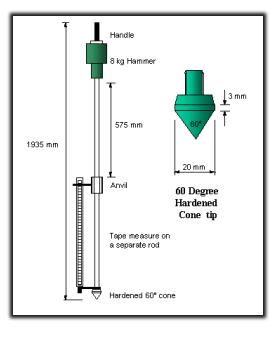
Once the test apparatus is assembled the DCP is placed at the test location and the initial penetration of the rod is recorded to provide a zeroing scale. While holding the rod vertically, the weight is raised to the top of the rod 575 mm above the anvil and dropped. The penetration of the rod is measured after each drop. In cohesive soils the penetration rod may be rotated slightly to prevent binding of the soil and the rod influencing test results. The test shall be terminated if the desired depth is reached or if the rod penetrates less than 1/8-inch in 10 drops.
The DCP test is conducted by lifting and dropping the hammer onto the anvil, and measuring the penetration of the DCP cone into the pavement layers. Data are typically collected by measuring the penetration after each 5 blows, up to a total depth of 800 mm.
Correlations to Engineering Parameters
Several correlations exist between common engineering parameters and the dynamic penetration index.
Where:
- CBR = California Bearing Ratio
- DPI = DCP Penetration Index
- SPT = Standard Penetration Test (ASTM D 1586-64)
Teaching this? Figures and worked examples are free to use with credit. How to cite
Cite this page
APA
Pavement Interactive. (2026, November 1). Dynamic cone penetration test. HeadLight. Retrieved [the date you read it], from https://pavementinteractive.org/reference-desk/pavement-management/pavement-evaluation/dynamic-cone-penetration-test/
ASCE
Pavement Interactive. (2026). “Dynamic Cone Penetration Test.” HeadLight, <https://pavementinteractive.org/reference-desk/pavement-management/pavement-evaluation/dynamic-cone-penetration-test/> ([the date you read it]).
BibTeX
@misc{pavint-dynamic-cone-penetration-test,
  author = {{Pavement Interactive}},
  title = {Dynamic Cone Penetration Test},
  year = {2026},
  publisher = {HeadLight},
  howpublished = {\url{https://pavementinteractive.org/reference-desk/pavement-management/pavement-evaluation/dynamic-cone-penetration-test/}},
  note = {Accessed [date]}
}